Gold was the glue of Viking society, and the longships took them to it. The strongest and wealthiest, Viking chieftains and kings ruled by giving generously to those under their command; trade and conquest filled the coffers of the kings, and the Viking Age simply would not have existed without the longship, the best boat of the day, taxis of terror and trade.1,2, 3
 |
| Viking trade gold; Flickr: by Arild Finne Nybø |
The
Vikings lived in a highly structured society with a chieftain-priest at the top. Below the
chieftain the class of freemen
included warriors, farmers, artisans, lawyers, and poets; these roles were fluid, and while every warrior was
also a farmer, some were also poets and blacksmiths, lawyers and priests.
Viking society also included slaves, the bottom of the social ladder; the slaves, often other people
captured during Viking raids, could
be killed in any season and for any reason.4,5,6
 |
| “Harald Finehair” Battle of Stiklestad, Pal Christian Eggen som konge i spelet 2014; Wikipedia |
During
the Viking Age, 800 to 1066, the Kings rose to ultimate power by might and bloody battle, killing or cowing all
other chieftains. Harald met a bedazzling princess who refused to marry him
unless he made something more
of himself. The frailty of the male eye, the lure of love, her face would launch a
thousand ships. To meet her challenge and gain her as his wife,
he aimed to conquer
all of Norway, and he refused to cut, comb or wash his hair until he achieved this
lofty goal. He succeeded by sea
using longships with berserks growling in the prow; only on the whale road or sea could he reach and defeat the
populated regions of mountainous Norway. After ten years, he
became that country’s
first King and when he finally did
wash,
cut and comb his hair for the wedding, people commented on how
fine his hair was, hence his
nickname: Harald Finehair.7,8,9
 |
| IMG_7023
“Reinas por una causa . Junio 2014. Miss Universe Canada”; Flickr: by Jorge
Mejía peralta |
The
Kings or chieftains won their place by military might, by winning battles and
killing their own kind, and the Vikings were eager to share their violence with others,
turning the Christian peace of Europe to pandemonium. The
Vikings prized a matrix of four interconnected virtues above all: courage, honour, generosity, and
loyalty.10
A
curious blend of fearlessness and fatalism guided them to face inevitable death
with stoic fortitude, an idea captured in the poem Havamal, The Sayings of the
High One: “Cattle die, wealth dies, kinsmen die, you yourself must one day die
but word-fame never dies for him who achieves it well.”11 The top god, the High One, Odin was an unscrupulous
philosopher-king worshipped by the Viking nobility, the poets and berserks; as
Lord of the Slain his animals the wolf and raven ate the dead bodies after
battles. The common folks worshipped Thor, whose name lives on in Thursday.12,
13
 |
| Huginn and Muninn sit on Odin's shoulders in an illustration from an 18th-century Icelandic manuscript – Wikipedia |
The
freemen, chieftains and kings were also strongly independent people, and this
appears in the very advanced, for the times, rights of women. Women were
married at a young age to men chosen by their fathers, but the Icelandic sagas
record numerous accounts of women playing an active role in this process.
Because the men rather frequently left home to fish, trade and raid, the women had to manage
the farms in their absence.
Viking women could own property, inherit estates and even divorce their
husbands.14,15
 |
| Backstage
Lancaster in Montreal; Flickr: by Mathieu Lebreton |
Here is an illustrative passage from Laxdaela saga:
Guðrún Ósvífursdóttir is introduced as "the most beautiful woman ever to
have grown up in Iceland, and no less clever than she was good-looking."
Guðrún has dreams that cause her concern. A wise kinsman interprets the dreams
to mean that Guðrún will have four husbands; she will divorce the first one but
the other three will die. And indeed, Guðrún marries her first husband at the
age of fifteen and he turns out to be a man she dislikes. She makes him a shirt
with a low-cut neck and then shortly thereafter divorces him on the grounds
that he wears women's clothing.16
Viking
kings and chieftain-priests
gained the gold for their
gifts by military conquest and increasingly by trade. The desire to extend the net of trade certainly
explains part of the volcanic movements of the Vikings in this period. The great
wealth in the Christian territories of Europe also attracted Viking swords like
a magnet. They got to the
gold by boat.17 In the firestorm that would be, overpopulation and
climate change made the tinder dry in Scandinavia, but the massacre of 4,500
pagan Saxons at Verden by Charlemagne in October of 782 provided the spark for
the conflagration; the resulting Viking attacks and the rise of the kings
provided a riposte to the military and ideological threats posed by such
Christian nation states.18
 |
| IMG_3052B
“Pierre Paul Rubens. 1577-1640. Anvers. Saint Ambroise et l'Empereur Théodose KHM
Vienne; Flickr: by jean louis mazieres |
The swan-breasted and swan-necked longships would
carry merchants and warriors to distant shores in search of the silver, gold
and other goods to fuel their gift-giving economy.19,20,21 Skimming
over the rough waves of the north Atlantic by sail, or rowed up a river, these
versatile and sleek swans took the adventurous and warlike Norse to lands far
west, east and south. The Viking craftsmen, important artists in the society,
built the hull first, overlapping the planks in what is termed the
clinker-built or lapstrake style, and the internal cross beams were often tied
to the ribs near the keel to provide added elasticity.22,23,24 Archaeology
has proven that Norwegians traded at Ribe, the oldest commercial centre in
Denmark, prior to the start of the Viking age, so the development of naval
skills and technology began under the aegis of peaceful trade.25
 |
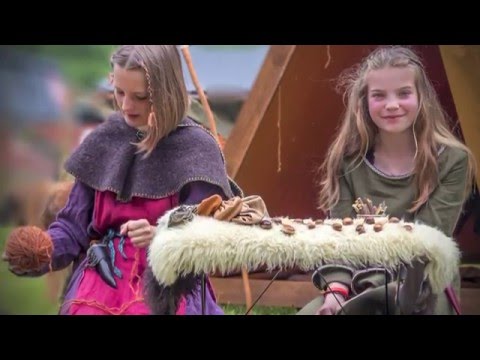
| Gudvangen
vikingmarknad 2015; Flickr: by Øyvind Nondal |
History, although sometimes written in stone, is
fragile like ice. Each historian and each age has limitations and biases, the
imperfections and shortfalls of our shared humanity, and the hard facts that
furnish history are often too many today and too few in the past.26 Modern
archaeology has greatly improved our knowledge of the Viking Age, but we owe a
debt to the early writings of Iceland, primarily the sagas, the only extant
written sources on the Vikings by a Viking people, our clearest window on that
past.27
End
Notes
1Magnusson, Magnus. Viking History Part 1 to Part 9. These ideas appear throughout Magnusson’s study. I
have written this like a newspaper article, so the first sentence is the lead; the
second expands on that lead, so hopefully this will help keep the focus.
2Richardson,
Hazel. Life of the Ancient Vikings. Pages 10 – 11. Throughout, I have used
Richardson’s interpretation, but very often supplemented it by adding personal
knowledge taken from an extensive reading of the Icelandic saga literature in
English translations.
3Wilkinson,
Philip. Vikings. Wilkinson, in his brief section “The Viking Classes” (on page
15) corroborates the more detailed examination by Richardson. He uses the word “Jarl”
instead of “Chieftain”, but I have chosen to avoid Norse words and use the
synonymous English words, hence my use of chieftain and chieftain-priest.
4Richardson,
Hazel. Life of the Ancient Vikings. Pages 10 – 11.
5Wilkinson,
Philip. Vikings. Page 15.
6Increased
nuance from the saga literature: all of the sagas are very clear on the fact
that the Viking society was not one with the kind of specialization we are
accustomed to. Egil’s Saga depicts Egil, the greatest poet of the Viking age,
as a farmer, warrior, poet and blacksmith; he certainly never made a living
from writing poetry, as perhaps Seamus Heaney does today! Njal’s Saga (considered
the masterpiece of the genre) revolves around a series of court cases, perhaps
the first of this genre! Each summer on the Logberg (Law rock) at the
democratic parliament of Iceland the Law-speaker would recite the laws of the
land; he completed it over a three-year period. The sagas are full of legal
wrangling, and though most often the lawyer was also the chieftain, freemen
also did testify in court settings acting on their own behalf as a lawyer. The
chieftain acted as the judge in such proceedings, or occasionally the King did.
7Magnusson. Viking History
Part 5: 3:30 – 9:37.
8Deary,
Terry. Horrible Histories: Vicious Vikings; page 57 – 58.
9Green, W. C., translator. Egil’s
Saga. This saga tells of
the descendants of Kveldulf, who fled Norway when Harold killed his talented
son, Thorolf Kveldulfsson. The family settles in Iceland after killing some of
the berserks of King Harold who killed their son and brother. Egil later kills
the son of the Norwegian king Erik Bloodaxe, continuing the process of revenge
between a chieftain family on noble birth living in Iceland and the kings of
Norway. A great deal of explicit detail on Harold Finehair appears in this
saga.
10Potter:
“The Vikings were cruel and relentless sea-rovers who honored three virtues
above all: courage, loyalty, and generosity.” (27) I added honor based on my
readings of the sagas and wider literature of such heroic societies. It appears
repeatedly, for example, in the legal fighting and the revenge that often
follows in the Icelandic sagas.
11 Magnusson.
Viking History Part 2: 6:11 – 7:03.
12McCoy,
Dan. Norse Mythology for Smart People.
Odin. Thor. McCoy offers some good scholarship on his online site, with
detailed and well selected references at the bottom of each entry.
13Encyclopedia Mythica. Origin of the Names of the Days. This is a wonderful site that could be useful for
any school teacher.
14Richardson,
Hazel. Life of the Ancient Vikings. Page 11.
15The
saga literature is full of stories about the human heart and the betrothal of
young girls. And well, yes, some of the Viking fathers would have been like Mr.
Capulet, Juliet’s harsh dad in Shakespeare, but some (perhaps most) loved their
daughters (and sons) deeply and did not deploy them like chess pieces. In my
mind, one of the most eloquent sagas on this theme is Laxdæla Saga. The unique freedom given to women appears in almost
every saga in some shape or form, and is an important idea I hope you keep.
Today, as you may know, the Nordic people continue to value and respect their
daughters, sisters, mothers and all other women. In fact “A Doll’s House” by the
great Norwegian dramatist Henrik Ibsen, which offers a strong critique of the
paternal control put upon women (no doubt as he observed in 19th
century Norwegian society), also advocates for the independence of women, so is
very much in the best of the Viking spirit! I think also it is no mistake that
the masterpiece of Halldor Laxness, the Icelandic Nobel laureate, was called Independent
People; trust me on this one, the Vikings have this in spades – men and
women both, kids and adults! My great-grandmother from Norway, whose English
was imperfect as a first generation pioneer in Canada, coined the word “stubbery”
to refer to us; she knew it well.
16Laxdaela
Saga. Wikipedia.
17Magnusson, Magnus. Viking History Part 1 to Part 9. Magnusson documents this throughout his
well-researched video series.
18Freyia
Völundarhúsins, Christophe Adrien, and Wikipedia (“Massacre of Verden”) all
support this hypothesis.
19Magnusson. Viking History
Part 2: 3:30 – 6:11.
20Magnusson. Viking History
Part 3: 10:15 – 11:41.
21Magnusson. Viking History
Part 4: 0:00 – 2:30; 7:45 – 10:55.
22Magnusson. Viking History
Part 2: 8:10 – 8:51.
23Magnusson. Viking History
Part 3: 10:15 – 11:41.
24Magnusson. Viking History
Part 4: 0:00 – 2:30.
25The Viking age began in Denmark web article relates this in more detail.
26My
final reflections on History, I believe are very well founded, both on the
limits of knowledge as reflected in Philosophy (i.e., Soren Kierkegaard and the
whole swarm of existential philosophers) and modern literature (i.e., the
masterpiece of William Faulkner “Absalom, Absalom” or throughout the
extensive oeuvre of another Nobel laureate Samuel Becket – my two favorite
recent authors, and men rightly regarded as having genius), and also in the
field of history as a discipline. Also the idea of “bias” is a hard one for
school-age children to understand, primarily because they lack the background
in significant readings that can arm them to see bias. Magnusson himself, as I
do implicitly in this final statement, notes his personal bias as an Icelander
in his video series, cited pervasively here; I think such intellectual humility
is warranted, and not widely expressed in such a vehicle as a Ted Ed animation –
but maybe I am wrong, you do such beautiful work, and not all known to me. One
Ted Talk that touches on this important issue (the limitations of human knowledge
– our umwelt) is the following: David Eagleman: Can we create new senses for
humans? The other insight here came to me years ago when I spoke with a
scholar of the French Revolution (1789 – 1799). He was one of the most highly
regarded scholars on this period, and he told us that the amount of primary
source data on this period was so extensive that no human being could possibly
even read it all! If this is the case, as I trust it is, for a period of
history in the late eighteenth century, just think of all the facts – primary
sources alone – for something like the First World War! I also read widely in
ancient Greek and Roman history, where the paucity of facts often comes to the
surface. The Dark Ages are dark because we know almost nothing about it, as
with dark matter and energy – our ignorance is pretty good!
27Again
this goes back to the brilliant scholarship of Magnusson. I hope also, that
from my notes, you also can detect how I have used my knowledge of Icelandic
literature to provide a more nuanced account of this topic.
Works
Cited
Adrien, Christophe. “Catalyst: How the Saxon Wars may have Sparked the
Viking Age.” 14 March 2015. Web. 30 December 2015.
Deary, Terry. Horrible Histories: Vicious Vikings. London: Scholastic
Children’s Books, 2007. Pages 57 – 58.
Eagleman, David. David Eagleman: Can we create new senses for humans? March
2015. Web. 7 September 2015.
Encyclopedia Mythica. Origin of the Names of the Days. 1995 – 2007. Web. 7 September
2015.
Green, W. C.,
translator. Egil’s Saga. 1893. Web. 23 August 2015.
Laxdaela Saga. Wikipedia. Web. 30 December 2015.
Magnusson, Magnus. “Viking
History Part 1 – Part 9.” YouTube: 21
October 2014. Web. 19 August 2015.
Massacre of Verden. Wikipedia.
Web. 30 December 2015.
McCoy, Dan. Norse Mythology for Smart
People. 2012 to 2015. Web. 7 January 2015.
Persson, Charlotte Price. “The Viking age began in Denmark.” 23 April 2015.
Web. 30 December 2015.
Potter, Simeon. Our Language. Harmondsworth, Middlesex, England: Penguin Books
Ltd. 1950. Print.
Richardson, Hazel. Life of the Ancient Vikings. New York: Crabtree Publishing Company, 2005.
Print. (Pages 10 to 11)
Völundarhúsins, Freyia. “The Real Origin of Viking Raids.” Wed. 30 December
2015.
Wilkinson, Philip. Vikings. London: Carlton Books
Limited, 2014. Print. (Page 15)
Works
Cited: Fair Use Images used in iMovie Video
1. liquid gold; Flickr: Creative Commons licensed for
noncommercial reuse with modification by milena mihaylova
2. Harald Fairhair (2); Flickr: Creative Commons
licensed for noncommercial reuse with modification by Sten Dueland
3. Gold filigree, Viking Museum; Flickr: Creative
Commons licensed for noncommercial reuse with modification by Brian Gratwicke
4. Viking long ship museum; Flickr: Creative Commons
licensed for noncommercial reuse with modification by Suw Charman-Anderson
5. The sagas of Icelanders; Flickr: Creative Commons
licensed for noncommercial reuse with modification by Helgi Halldorsson.
6. Wax figures in the Saga Museum; Flickr: Creative
Commons licensed for noncommercial reuse with modification by RJ
7. The well-preserved head of the Tollund man,
“Tollundmannen” – Wikipedia by Sven Rosborn, the free encyclopedia; Google
search labelled for noncommercial reuse with modification
8. Lofotr Viking helmet and sword; Flickr: Creative
Commons licensed for noncommercial reuse with modification by Kjell Joran
Hansen
9. IMG_7023 “Reinas por una causa . Junio 2014. Miss
Universe Canada”; Flickr: Creative Commons licensed for noncommercial reuse
with modification by Jorge Mejía peralta
10. Counties of Norway; Flickr: Creative Commons licensed
for noncommercial reuse with modification by Bjørn Normann jr.
11. Berzerker chess piece: Creative Commons licensed
for noncommercial reuse with modification by Jon Wiley
12. “Harold Finehair” Battle of Stiklestad, Pal
Christian Eggen som konge i spelet 2014; Wikipedia, the free encyclopedia;
Google search labelled for noncommercial reuse with modification
13. Arbo-Olav den helliges fall i slaget på Stiklestad
- Battle of Stiklestad; Wikipedia, the free encyclopedia; Google search
labelled for noncommercial reuse with modification
14. Settlement of Iceland, “Viking Expansion” –
Wikipedia, the free encyclopedia; Google search labelled for noncommercial
reuse with modification
15. Huginn and Muninn sit on Odin's shoulders in an
illustration from an 18th-century Icelandic manuscript – Wikipedia, the free
encyclopedia; Google search labelled for noncommercial reuse with modification
16. Laocoön V; Flickr: Creative Commons licensed for
noncommercial reuse with modification by Nick Thompson
17. 10th century Eyrarland statue of Thor found in
Iceland “Þrymskviða” – Wikipedia, the free encyclopedia; Google search labelled
for noncommercial reuse with modification
18. Backstage Lancaster in Montreal; Flickr: Creative
Commons licensed for noncommercial reuse with modification by Mathieu Lebreton
19. Signe Hasso; Flickr: Creative Commons licensed for
noncommercial reuse with modification by kate gabrielle
20. Yohanna & Friðrik; Flickr: Creative Commons
licensed for noncommercial reuse with modification by Daniel Kruczynski
21. Sonja Henie - early 1940s - Sonja - from Norway -
The ice skating movie star; Flickr: Creative Commons licensed for noncommercial
reuse with modification by BJ Alias
22. Viking trade gold; Flickr: Creative Commons
licensed for noncommercial reuse with modification by Arild Finne Nybø
23. Viking Voyages; Wikimedia; Google search labelled
for noncommercial reuse with modification
24. Equestrian statue of Charlemagne by Agostino
Cornacchini 1725 CE; Flickr: Creative Commons licensed for noncommercial reuse
with modification by Mary Harrsch
25. IMG_3052B “Pierre Paul Rubens. 1577-1640. Anvers.
Saint Ambroise et l'Empereur Théodose KHM Vienne; Flickr: Creative Commons
licensed for noncommercial reuse with modification by jean louis mazieres
26. Viking long ship museum; Flickr: Creative Commons
licensed for noncommercial reuse with modification by Suw Charman-Anderson
27. The Viking Warship "Sea Stallion";
Flickr: Creative Commons licensed for noncommercial reuse with modification by
William Murphy
28. Le bateau viking d'Oseberg; Flickr: Creative
Commons licensed for noncommercial reuse with modification by Jean-Pierre
Dalbéra
29. Gudvangen vikingmarknad 2015; Flickr: Creative
Commons licensed for noncommercial reuse with modification by Øyvind Nondal
30. Gudvangen vikingmarknad 2015; Flickr: Creative
Commons licensed for noncommercial reuse with modification by Øyvind Nondal
31. lund university library rune stone (detail);
Flickr: Creative Commons licensed for noncommercial reuse with modification by mararie
32. fpx073011-33; Flickr: Creative Commons licensed
for noncommercial reuse with modification by Dennis Hill
