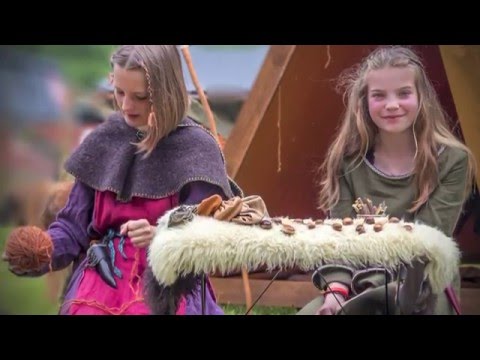
Our clearest window on the Vikings appears in the early writings of Iceland – primarily the sagas, the greatest vernacular literature of medieval Europe. These stories of kings and common heroes help bring that age to life in our imagination.1,2,3,4
 |
| Island 2013 778 Reykjavik – Perlan – Saga Museum: Flickr |
The swan-breasted
and swan-necked Viking
longship fueled the Viking age from 800 to 1066.5
An engineering marvel, these ships would carry merciless and relentless
sea-rovers from Norway west to the Orkneys, Iceland, Greenland and to L’Anse aux
Meadows in Newfoundland in the year 1000.6,31 The Viking craftsmen built the hull first,
overlapping the planks in what is termed the clinker-built or lapstrake style,
and the internal cross beams were often tied to the ribs near the keel to
provide added elasticity. They were the stealth bombers of the day.7,8,9
 |
| Viking long ship museum; Flickr |
Skimming over the
rough waves of the north Atlantic by sail, or rowed up a river, these versatile
and sleek swans took the adventurous and warlike Norse to lands more promising
than their own, and they hungered in time for new homes in sunnier climes with
more fertile earth.10,11 According to
the sagas, the unifying efforts of Harold Finehair, the first King of Norway,
forced many freedom loving Norwegians to set sail west, and some of these displaced
Norwegians, both nobles and farmers, transplanted their democratic and literary
heritage and habits in Iceland, a fortress of Norse culture.12
The best poets of
the period were Icelanders, and some even served in the court of English kings,
so similar were the related Gothonic languages. These poems often provide the
skeleton on which the narrative of the sagas hang and the intricate nature of
these poetic compositions ensure that seeds of history abide in them.13,14
Viking poets used elaborate metaphors or kennings so that the ‘whale road’ was
the ocean, and the ‘fish of the forest’ a dragon.15,16
 |
| Humpback Whale; Flickr |
The greatest of
these poets, Egil
Skallagrimsson, stood head and shoulders above his Viking
peers. Jesse Byock in using science to illuminate the past credibly suggests
that this ugly and massive man suffered from an ailment called Paget’s disease
that deformed and thickened his bones. Egil also lived the Viking life and
wrote of it with eloquence.17
Shipwrecked on the
coast of England at the mouth of the Humber, Egil and his men find themselves
near York, then ruled by his enemy Erik Bloodaxe, former King of Norway.
Viewing it shameful to flee, he marches fully armed into the hall of Erik. The
strong-willed Queen Gunnhilda suggests that they kill him outright, but it
being night that was viewed as a crime, so Erik bids Egil goodnight, tomorrow
he will die. A common friend, Arinbjorn provides an unlikely way out; in the night
Egil must compose a poem of praise about his enemy Erik, a head-ransom poem.
The next morning, he
recites his poem in a clear, strong voice. The entire head-ransom poem appears
in chapter sixty-three of the saga, a poem of twenty stanzas. Although Egil has
killed kinsmen of the king and queen, he is set free, and this gets to
something crucial about the minds of these men.18
 |
| Egil Skallagrimsson, Wikimedia |
The
Vikings prized a matrix of four interconnected virtues above all: courage,
honor, generosity, and loyalty.19 A curious blend of fearlessness
and fatalism guided them to face inevitable death with stoic fortitude, an idea
captured in the poem Havamal, The Sayings of the High One: “Cattle die, wealth
dies, kinsmen die, you yourself must one day die but word-fame never dies for
him who achieves it well.”20 The poem promises immortality to Erik,
so he frees the killer of his own son, an act of incredible generosity.21
To the East the longships took the Swedish Rus along
rivers to build Novgorod and Kiev, the first towns in the country that would
take their name, Russia. But the most highly contested prize was south , and in the Viking Age Norwegians and
Danes shocked the shores of Ireland, the United Kingdom and France, a hammer
from the North.22,31
 |
| Settlement of Iceland, “Viking Expansion” – Wikipedia |
The
Norwegians created the first towns in Ireland including Dublin; and the great
Dane Canute, the most capable King of medieval England, also ruled Norway and
Denmark well;23,24 the Norse Normans took England with William the
conqueror in 1066 to end the Viking age and to seed English with French and
Latin words.25,26,31 But one, more significant contribution remains.
The
eagerness of Vikings in the Danelaw to communicate with their southern
Anglo-Saxon neighbors produced a friction that led to the erosion of the
complicated inflectional word-endings, so that the English language increased
in simplicity, clarity, directness and strength. 27,28,30
Professor
Tom Shippey vividly explains the loss of grammatical word endings; someone from
south of the Danelaw might say in Old English: “Ic selle the that hors the
draegeth mine waegn.” A Viking a bit North might say it this way: “Ek mun selja
ther hrossit er dregr vagn mine.” With some words in common, they roughly
understand each other; in time the inflections melted away and this remained: “I’ll
sell you the horse that drags my wagon.”28
This Viking-bred English dispensed from the north,
insatiable in seeking distant shores, has a hoard now of about one million
words.27,28,29,30
Lastly,
the Vikings soon turned swords into plowshares, and like all good immigrants, they
quickly assimilated.31
End Notes
1
Magnusson. Viking History Part 1: 0:40 – 2:03; 2:30 – 3:00.
2Hauptmann.
3“Icelandic
Literature.”
4Byock.
5Magnusson.
Viking History Part 1: 0:40 – 2:03.
6Magnusson.
Viking History Part 2: 3:30 – 6:11.
7Magnusson.
Viking History Part 2: 8:10 – 8:51.
8Magnusson.
Viking History Part 3: 10:15 – 11:41.
9Magnusson.
Viking History Part 4: 0:00 – 2:30.
10Magnusson.
Viking History Part 3: 10:15 – 11:41.
11Magnusson.
Viking History Part 4: 0:00 – 2:30; 7:45 – 10:55.
12Magnusson.
Viking History Part 5: 3:30 – 9:37.
13“Icelandic
Literature.”
14Byock.
15Magnusson.
Viking History Part 4: 3:40 – 4:15.
16Byock.
17Byock.
18Green. Egil’s Saga. Principally chapters 36;
43-45; 48; 49; 57–60; 62-64.
19 Potter:
“The Vikings were cruel and relentless sea-rovers who honoured three virtues
above all: courage, loyalty, and generosity.” (27)
20Magnusson.
Viking History Part 2: 6:11 – 7:03.
21Green. Egil’s Saga. Principally chapters 57–60;
62-64.
22Magnusson.
Viking History Part 7: 2:47 – 6:30.
23Magnsson.
Viking History Part 7: 7:00 – 8:12.
24Cantor: “The
most effective king in Anglo-Saxon history was the early eleventh-century
Danish conqueror Canute.” (166)
25Magnusson.
Viking History Part 8: 0:55 – 3:20.
26Magnuson.
Viking History Part 9: 0:00 – 1:22: 4:08 – 10:01.
27Potter: “No
less far-reaching was the influence of Scandinavian upon the inflexional
endings of English in hastening that wearing away and leveling of grammatical
forms which gradually spread from north to south. It was, after all, a salutary
influence. The gain was greater than the loss. There was a gain in directness,
in clarity, and in strength.” (33)
28McCrum:
70-71.
29Crystal:
32 (loss or rapid increase in loss of inflectional endings due to Vikings in
Danelaw); 119. “It is difficult to see how even a conservative estimate of
English vocabulary could go much below a million lexemes. More radical
accounts, allowing in all of scientific nomenclature, could easily double this
figure.” (119)
30“BBC
Documentary English Birth of a Language”: 35:00 to 37:20
31”Vikings,
the Founders of Europe” passim.
Works Cited
“BBC Documentary English Birth of a Language” YouTube. 27 July 2013. Web. 19 August
2015.
Byock,
Jesse. “Egil’s Bones.” Scientific
American, January 1995: 82 – 87. Web. 22 August 2015.
Cantor,
Norman. The Civilization of the Middle Ages. New York: HarperPerennial,
1994. Print.
Crystal,
David. The Cambridge Encyclopedia of the English Language. Cambridge:
Cambridge University Press, 1995. Print.
Green,
W. C., translator. Egil’s Saga. 1893. Web. 23 August 2015.
Hauptmann,
Katharina. “Icelandic Medieval Literature and Sagas.” Wall Street International. 24 May 2014. Web. 22 August 2015.
“Icelandic
Literature.” Wikipedia. Web. 22
August 2015.
Magnusson,
Magnus. “Viking History Part 1 – Part 9.” YouTube:
21 October 2014. Web. 19 August 2015.
McCrum,
Robert; William Cran, and Robert MacNeil. The Story of English. London: Faber
and Faber, 1987. Print.
Potter,
Simeon. Our Language. Harmondsworth, Middlesex, England: Penguin Books
Ltd. 1950. Print.
“Vikings,
the Founders of Europe.” YouTube. 3
December 2014. Web. 28 December 2015.
Works Cited:
Fair Use Images
(For the Video)
1. Island 2013 778 Reykjavik –
Perlan – Saga Museum; Flickr: Creative Commons licensed for noncommercial reuse
with modification by Klaus Nahr
2. Viking long ship museum; Flickr:
Creative Commons licensed for noncommercial reuse with modification by Suw
Charman-Anderson
3. Settlement of Iceland, “Viking
Expansion” – Wikipedia, the free encyclopedia; Google search labelled for
noncommercial reuse with modification
4. Clinker – caravel; Google search
labelled for noncommercial reuse with modification
5. Gokstad ship replica and a small
boat at Borgpollen; Flickr: Creative Commons licensed for noncommercial reuse
with modification by Juanjo Marin
6. “Harold Finehair” Battle of
Stiklestad, Pal Christian Eggen som konge i spelet 2014; Wikipedia, the free encyclopedia;
Google search labelled for noncommercial reuse with modification
7. Iceland Lomagnupur; Flickr:
Creative Commons licensed for noncommercial reuse with modification by Niklas
Sjoblom
8. Saga Museum; Flickr: Creative
Commons licensed for noncommercial reuse with modification by Alyson Hurt
9. Humpback Whale; Flickr: Creative
Commons licensed for noncommercial reuse with modification by Robbie Shade
10. Egil Skallagrimsson 17c
manuscript; Wikimedia: Google search labelled for noncommercial reuse with
modification
11. Luigi Cattaneo Museum, Institute
of Human Anatomy, Bologna; Flickr: Creative Commons licensed for noncommercial
reuse with modification by Scott D. Haddow
12. stormy_seas_; Flickr: Creative
Commons licensed for noncommercial reuse with modification by Ishtaure Dawn
13. The snow queen; Flickr: Creative
Commons licensed for noncommercial reuse with modification by Michal Grajkowski
14. The Vikings are coming; Flickr:
Creative Commons licensed for noncommercial reuse with modification by Chris
Jones
15. The King Defended; Flickr:
Creative Commons licensed for noncommercial reuse with modification by CGP Grey
16. Immortal; Flickr: Creative
Commons licensed for noncommercial reuse with modification by KOREphotos
17. (Repeated image) Settlement of
Iceland, “Viking Expansion” – Wikipedia, the free encyclopedia; Google search
labelled for noncommercial reuse with modification
18. Canute – North Sea Empire;
Wikipedia, the free encyclopedia; Google search labelled for noncommercial
reuse with modification
19. William the Conqueror; Flickr:
Creative Commons licensed for noncommercial reuse with modification by B
20. Danelaw; Wikipedia, the free
encyclopedia; Google search labelled for noncommercial reuse with modification
21. Oxford English Dictionary Entry
Slips; Flickr: Creative Commons licensed for noncommercial reuse with
modification by Media Specialist
22. “We shall beat our swords into
plowshares.” Sculptor E. Vuchetich; Flickr: Creative Commons licensed for
noncommercial reuse with modification by Mark B. Schlemmer

